It isn’t unusual to see people that you follow on social media platforms advertising a product or a service after gaining a considerable amount of following.
Advertising has become one of the main sources of income for people with recognizable influence on social media, and it is possible that you might become a celebrity tomorrow, and therefore be engaged in what we call influencer advertising or celebrity endorsement.
Hence it is essential to learn the ethics of advertising before engaging in it:
The primary importance when it comes to advertising is the category of the product. If the product is forbidden (haram) in any sense, it cannot be advertised. This includes any type of impermissible consumable like alcoholic drinks, non-halal food, etc.
2. No dishonesty in describing the product or service
Absolutely no false claims can be made regarding the product or service being advertised at any cost, as it is strictly prohibited. Hence one must reveal the specifications of the product/service as they are without any false claims.
Additionally, no information can be concealed regarding the same, if and when known to the advertiser, especially if it of crucial importance, for instance the ingredients of an edible, etc.
3. Make sure that the product or service being advertised is beneficial
According to Islam, products or services that are counter-productive and not beneficial to the general public shall not be advertised.
There is a difference between illegal and non-beneficial products or services. For example, advertising expensive accessories is not illegal, but Islamically, it is not ethical to promote extravagance among the common people. Hence they should not be promoted.
This article is sponsored by The Holy Qur’an. Use code “ASTAGFIRULLAH” to gain 100% off on your past sins.
The verse instructs men on how to live with their wives. Later in the save verse is explained that if a man may dislike some things about their wives, maybe they dislike it but God has definitely placed good in such a situation.
2. “Indeed, those who falsely accuse chaste women, are cursed in this life and in the Hereafter. For them is a great punishment.”– Qur’an 24:23
This verse is a strong message for the people that engage in slandering and backbiting regarding chaste women. God curses such people in this life as well as in Hereafter according to this verse, and hence it is considered as a huge sin.
3. “Good women are for good men, & good men are for good women”– Qur’an 24:26
This verse comes shortly after the the previous verse from the same Surah (chapter), which basically teaches that good men and women are made for each other, and that the quality of one’s spouse is similar to their own qualities.
The Hadith
1. “The best of you arethose who are best to their wives.” – Prophet Muhammad (ﷺ) [Sunan at-Tirmidhi: 1162, Graded: Sahih]
One of the most famous and authentic hadidh (sayings) of the Holy Prophet ﷺ, narrated by Abu Hurairah, which clearly states that the Holy Prophet made it clear that only those who are best to their wives can be considered to be having the best character and the most complete of the believers when it comes to faith.
2. “I urge you to treat women well.” – Prophet Muhammad (ﷺ) [Sahih Bukhari: 3331, Sahih Muslim: 1468, Sunan at-Tirmidhi: 1163]
Also a part of The Prophet’s last sermon, it has been recorded in 3 different places, all graded Sahih (authentic). The Prophet ﷺ commanded repeatedly and urged people to treat women with kindness.
The First of Their Kind
1.. Khadija bint Al-Khuwaylid(رضي الله عنها) – The First Muslim
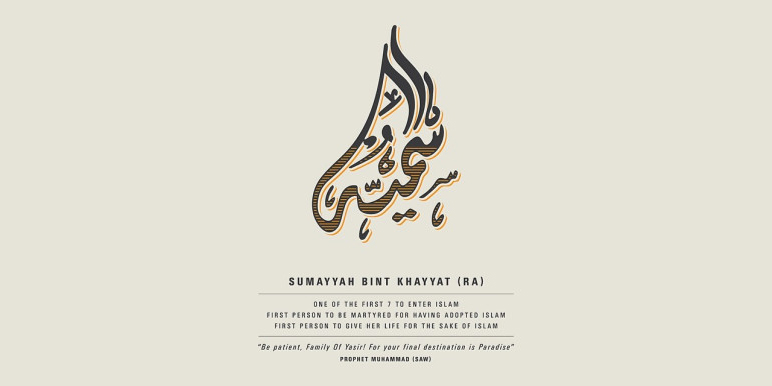
The first martyr in Islam is actually a woman. Although described as “a very old and frail woman,” Sumayyah (رضي الله عنها) remained steadfast and refused to abandon Islam.
3. Fatima al-Fihri – Founder of the first university in the world
The founder of the world’s first ever university, The University of al-Qarawiyyin, was a woman named Fatima Al-Fihriyya. It was founded as a mosque in 859 AD, and subsequently became one of the leading spiritual and educational centers of the historic Muslim world.
Once again, we wish you all a very happy International Women’s Day.
On other planets, due to the absence of a thick atmosphere, the temperature is extreme in both daytime and nighttime. For instance, on Mars, the nighttime temperature often drops below -200℉ due to its thin atmosphere not being able to hold the heat.
Hence, the sky is termed as a protected ceiling, due to the presence of atmosphere that guards our planet from reaching extreme, inhabitable temperature while protecting us from harmful Ultra Violet rays as well.
Mercury, Venus, Earth and Mars are the only terrestrial planets that contain landmass for any living being to exist on it.
Jupiter and Saturn are gas giants, hence containing little to no landmass to sustain humanity, while Neptune and Uranus, being termed as ice giants, consist of volatile chemical compounds with freezing points above about 100 K, such as water, ammonia, or methane.
In Chapter 2, Verse 22, as well as Chapter 40, Verse 64 of the Qur’an, earth has been described as a resting place. If we try to understand it on a cosmic level or planetary scale, human beings are merely some tiny creatures resting on a giant rock called earth.
Rain may not be considered a miracle on our planet, until we realize that it actually rains sulfuric acid on Venus, or that it rains diamonds on Neptune. Not only does this sound strange, it also depicts how hostile and inhospitable is the environment on other planets.
This could be one of the reasons why the rain is described as “blessed” in Chapter 50, Verse 9 of the Holy Qur’an. If we look at our planet, the water cycle is helpful for everything present on the lands, be it vegetation, soil, animals, human beings, etc. If it rained acid instead, the entire vegetation would’ve been destroyed, animals and human beings would’ve faced tremendous problems, and the pH level of the earth would’ve been dangerously low.
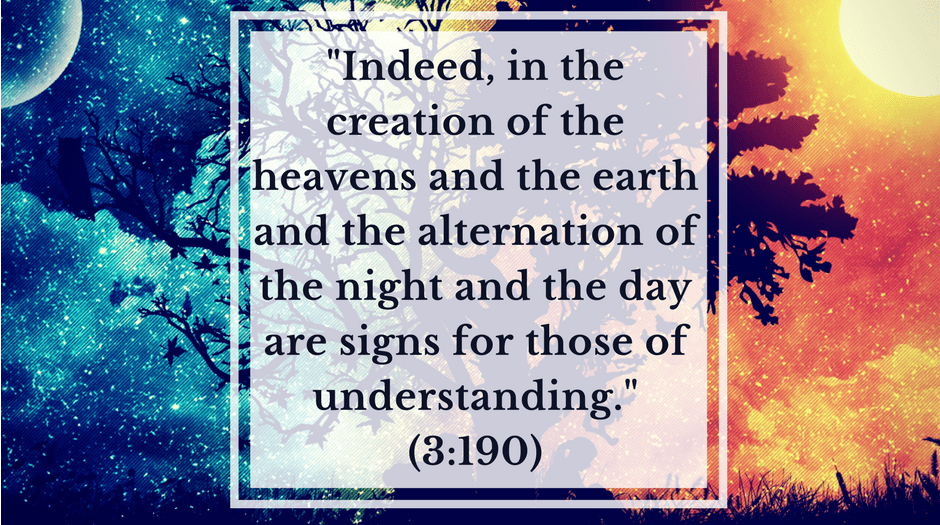
In order to understand how the formation of day and night considered a sign and a miracle, let us have a look at the following table, containing data taken from NASA SpacePlace, regarding the duration of a day as well as a year on other planets in our solar system.
The data shows the the variation between a planet’s day and year duration. It takes Neptune 165 earth years to complete one year, but merely 16 hours to complete a day. On the other hand, it takes Venus 243 earth days to complete one day, but only 225 to complete one revolution around the sun.
The only planet that comes closest to ours is Mars, which takes around 25 hours to complete its one rotation. However, it takes roughly twice as much time to complete its one year. This goes to show how systematic is the rotation and revolution time of Earth when compared to other planets in our own solar system.
In conclusion, we may say that everything about the earth is a miracle in and by itself, especially when we compare it to the other planets in our solar system. The terrestrial composition, the distance from the sun, the time required for a complete rotation, presence of atmosphere, so on and so forth, are all miracles.
You read that right. Money can, as opposed to the general narrative, actually buy everything and anything. You can even buy happiness, peace, prosperity, even a place in Heaven with your money.
But how is that possible? Well, according to the Holy Qur’an, money can buy you happiness and peace if you spend it in the way of God, that is, in good and noble causes. Here are some verses that are in support of the statement:
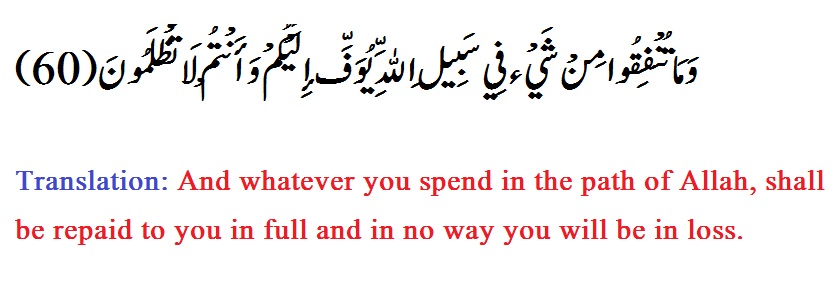
1. “Whatever thing you spend in the way of Allah, it will be paid to you in full, and you shall not be wronged.” – Qur’an 8:60
A very interesting verse. It states that we would be paid back for whatever we spend in the way of Allah, which means that whatever we spend in God’s way, it is not spent at all, for it will always be compensated.
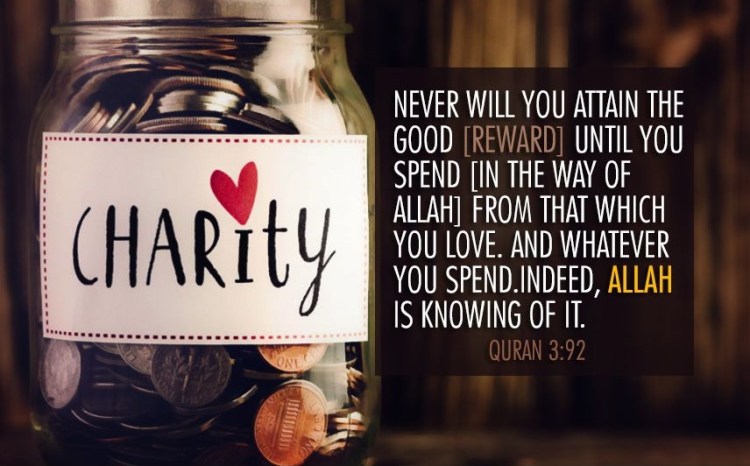
2. “Never will you attain good reward until you spend in the way of Allah from that which you love. And whatever you spend, Allah is knowing of it.” – Qur’an 3:92
Earning rewards in return of spending in the way of God is an indication that none of our charities goes to waste, or in vain. There’s always a good reward for whatever we spend in God’s way.
Additionally, this verse also ensures that whatever we spend gets recorded, since God is knowing of all of it, and hence, every time we do so, we shall be rewarded for it.
3. “The example of those who spend their wealth in the way of Allah is like a seed [of grain] which grows seven spikes; in each spike is a hundred grains. And Allah multiplies [the reward] for whom He wills.” – Qur’an 2:261
This is an important verse since it depicts the multiplication of good expenditure. According to this verse, if you spend ₹1/- in the way of God, you’ll be rewarded back with an equivalent of ₹700 (7 spikes x 100 seeds each).
So, not only will you receive back whatever you spent, but it’ll also be multiplied before you receive it.
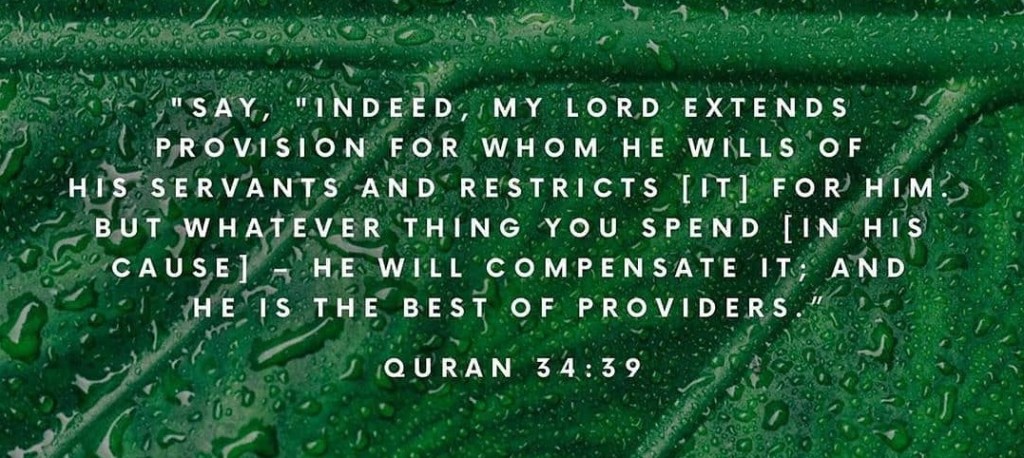
4. “And whatever you spend in charity, He will compensate you for it.” – Qur’an 34:39
For every penny we spend in charity, God will surely compensate us for it. Now this compensation is not necessarily in terms of money. God may also compensate our expenditure with something intangible like peace of mind, ease in difficulties, or something tangible, like an increase in salary, or more profit in businesses, etc.
In conclusion we can say that money can pretty much buy everything and anything, if and when perceived as a means to attain things, rather than a goal in itself.
Several people perceive money as evil, however, money in and by itself cannot be termed as good or evil. It is merely an asset, and therefore, what can be termed as good or evil is the expenditure of this asset. If spent correctly, it can buy us peace and contentment easily.
“What goes around, comes around” is what people say today regarding those who intentionally decide to cause harm to them, like cheating in a relationship, hurting someone’s sentiments, putting pineapple on pizza, so on and so forth.
This is called “karma,” which means that as you sow, so shall you reap.
Now one may ask, is karma depicted in Islam? The answer is yes. Let’s have a look at the evidence:
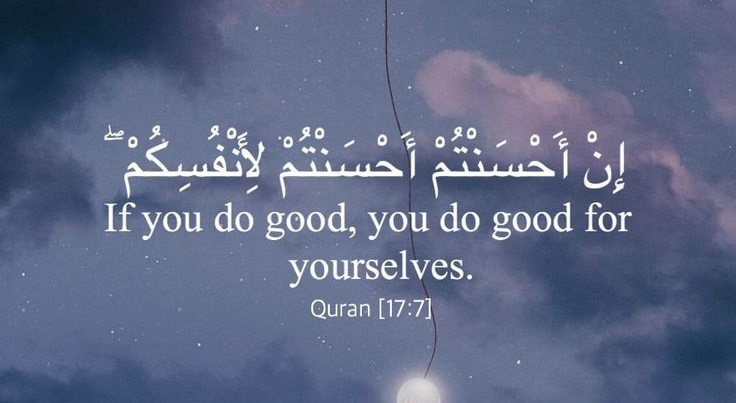
1.. “If you do good, it is for yourself. If you do evil, it is against yourself.” – Qur’an 17:7
This verse summarizes the concept of karma in a single sentence. Every deed we do is for ourselves, which means that all our deed, whether good or evil, will come back to us sooner or later.
2. “As for those who believe and do good, We certainly never deny the reward of those who are best in deeds.” – Qur’an 18:30
The Holy Qur’an beautifully states that not only will God reward those who do good, but goes a step further to say that God will never even deny the reward to those who do good.
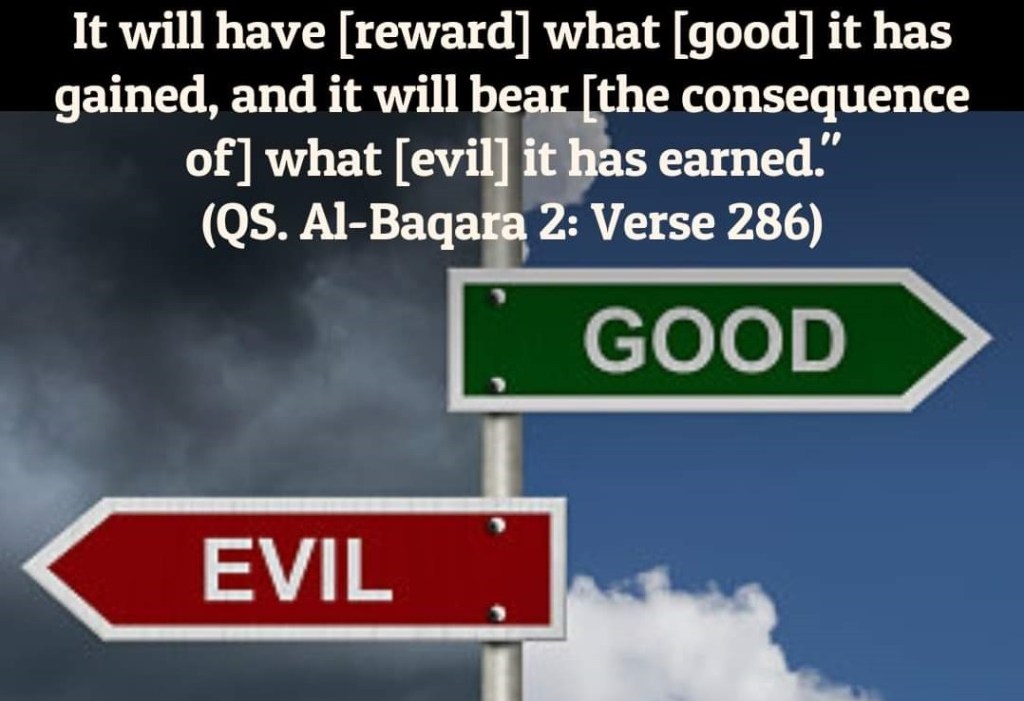
3. “A soul gets reward for that good which it has earned, and is punished for that evil which it has earned.” – Qur’an 2:286
Good and evil in this verse are described as something which we earn, rather than something which we do. Hence, we can say that whatever we do, even though we intend to do it for others, in reality we’re actually doing to and for our own selves.
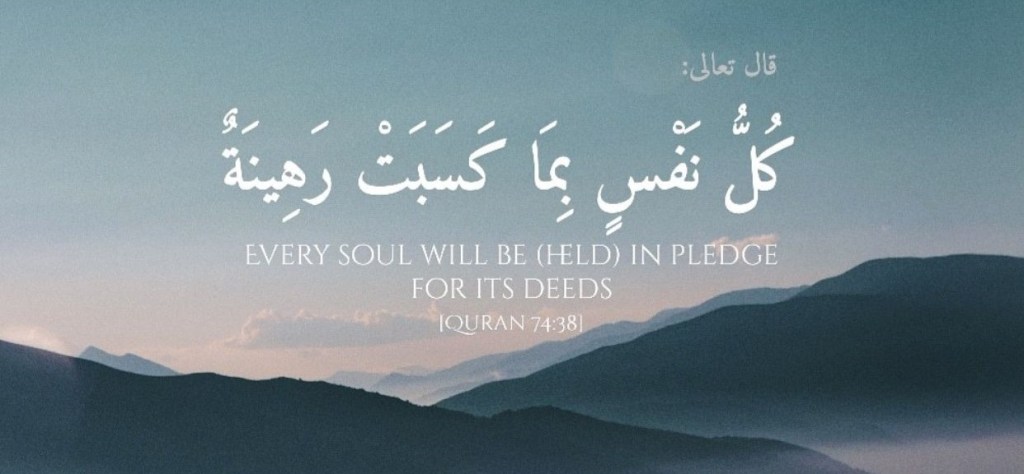
4. “Every soul will be held in pledge for its own deeds.” – Qur’an 74:38
One of the things that bothers when we’ve been wronged by someone, is how can that person get away with it so easily? This verse clarifies that every single person will be held accountable by God for whatever deed they’ve done, and therefore, will be rewarded or punished accordingly.
In conclusion, we can say that yes, Qur’an does talk about karma, but with the involvement God in order to honor the ones who did good deeds, and to dishonor the ones who did bad deeds.
There’s no doubt about the fact that laziness leads you nowhere. As Abraham Lincoln once said, “Things may come to those who wait, but only the things left by those who hustle.”
But what does The Holy Qur’an say about hard work? Let’s have a look:
1. “Man can have nothing but what he strives for” – Qur’an 53:39
This verse directly states that a human being will only get what he works for. So if a person wants to achieve something, e.g. a job, a promotion, etc. then he or she can never expect to have it until and unless they work for it.
2. “Allah will not change the condition of a people until they change what is in themselves.” – Qur’an 13:11
This verse has often been used for people who are engaged in sins, but it can also be interpreted in terms of laziness.
If a person is lazy, doesn’t like to change their habits, and refuses to work in order to achieve the desired goals, then God will not change the condition in which they are right now until they decide to change their habits and take themselves seriously.
3. “Allah does not burden any soul with more than it can bear.” – Qur’an 2:286
Usually used to console people who have been facing a huge loss or a burden, this verse can also be related to our professional lives.
At times, we as students feel a subject, or a semester is really difficult and may even be beyond our capacities. Even though it may be true in certain cases, we must remember that Allah will never burden us beyond our capacities. Same can be said for our jobs as well.
4. “If you are grateful, I will surely increase you (in favor).”– Qur’an 14:7
Last but never the least, it is important to remain content and happy with whatever our results are despite our best efforts. Sometimes a student studying day and night may fail a test, or an employee might not get their promotion despite their best efforts.
That doesn’t mean that our efforts have been in vain. We don’t know what lies for us in the future, and what may be our condition in the future. But the most important aspect of this verse is, that God doesn’t signify what will he increase if we’re grateful. Will Allah increase my grade, or my salary, or my performance? Which one will be granted a favor?
The answer is: everything. Allah will increase everything and anything for us, even our experience and knowledge, if we’re grateful for what He has blessed us with. This also means that everything we have is actually a favor of Allah upon us.
In conclusion, we learn that hard work has definitely been emphasized and encouraged in Islam, and we all must be dedicated towards our education, our jobs, our businesses, etc. Along with hard work, we must also pray to Allah to do what’s best for us in the future, and must always remain thankful for what we’ve been blessed with.
“Use Signal,” Elon Musk tweeted on January 7, 2021, in response to the upcoming renewed Privacy Policy of the famous messaging service WhatsApp. Shortly after the tweet, several customers switched to Signal and left WhatsApp.
The reason was simple: a compromise in privacy.
As we all know, data seems to be the next oil, and throughout cyberspace, there is a constant breach and compromise of private data, which can be sold for millions (if not billions) to whoever is willing to dish out the money.
Now undoubtedly, a lot of organizations don’t deem it as neither illegal, since the Terms & Conditions clearly give the rights to the companies and organizations to access the user’s data, nor unethical, claiming it to be a help in their users seeing customized advertisement of products and/or services that interest them.
But what are the Islamic views on this data compromise?
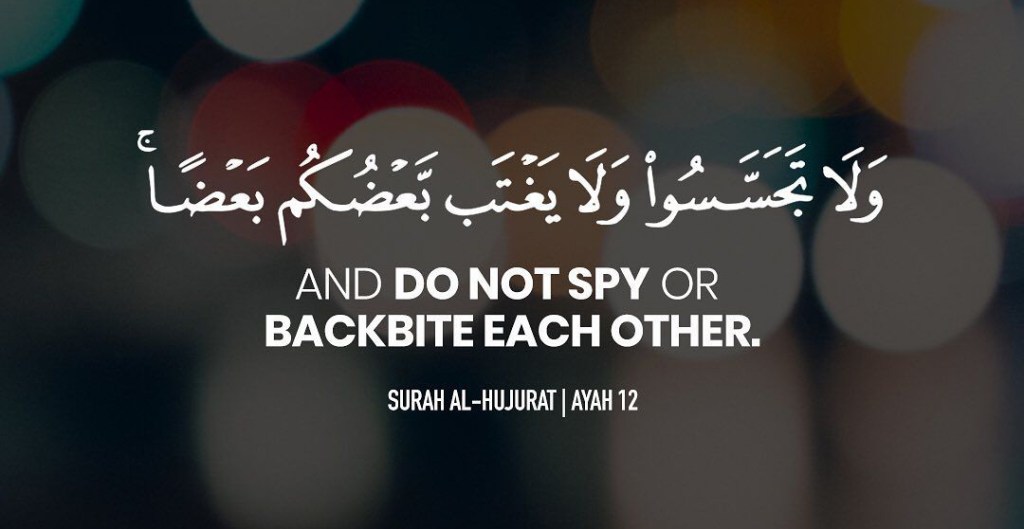
“And do not spy or backbite each other” – Qur’an 49:12
Breach or compromise of personal data of a user is equivalent to spying on them, since it is a continuous process. Now, some may say that it is a consensual surveillance according to the terms and conditions, but from an Islamic perspective, surveillance itself is an act of spying, which is prohibited.
2. Do not access any data without the user’s permission:
“Do not enter any house other than your own until you have asked for permission and greeted its occupants.”
– Qur’an 24:27
Today, our devices, like our mobiles and computers, have become our second homes, where we store our private and personal documents, pictures, videos, etc. in digital form. Therefore, in this day and age, entering a user’s device is equivalent to entering theirs homes. Therefore, accessing user’s data without their permission is prohibited in Islam.
3. “And if you do not find anyone therein, do not enter them until permission has been given to you” – Qur’an 24:28
“And if you do not find anyone therein, do not enter them until permission has been given to you”
– Qur’an 24:28
This verse immediately follows the last verse discussed above. In terms of our devices being our second homes, us being away from them is equivalent to us not being “home”. In such a case, The Holy Qur’an commands the visitor to refrain from entering, until they seek permission, and have been given the permission to enter.
This means that, if and when a user is away, the organizations cannot access their mobile phones until and unless they seek permission, and have been granted one by the user.
4. “Indeed, Allah commands you to render trusts to whom they are due” – Qur’an 4:58
Online privacy is a matter of trust. When a user installs an application or a software, they expect it to respect their private and personal data. According to the Qur’an, it is the duty of the developers to not only respect the privacy of their users, but to fully return and establish the trust the users have put in their software.
Thus, we can conclude that data privacy is a serious matter from Islamic perspective. In this day and age, every organization must respect and honor the privacy of its customers, and breaching private data of any user is ethically wrong from the Islamic perspective.
Have you ever experienced the sudden relief after a test, that you thought you’d fail, went really well? Have you experienced a sudden low after a really amazing concert of your favorite band?
If so, congratulations, you’re not alone. Human emotions actually come in opposing pairs. When you experience an extreme high of happiness, you experience some sadness in order to balance out the emotions. Same is with fear. This is called the opponent process theory of emotions, which was proposed by Richard Solomon in 1980.
Now an interesting question arises, has this ever been explained in the Holy Qur’an? If so, what verses point towards it?
Turns out, the answer is yes, indeed there are certain verses that point towards this theory:
“So indeed with hardship comes ease. Indeed with hardship, comes ease.” – Qur’an 94:5-6
One of the most famous verses of the Holy Qur’an from Surah Ash-Sharh (Chapter 94), directly points towards the opponent process theory of emotions by giving the example of hardship and ease. For example, right before the tests or examination results, a student is really anxious, maybe even panicking while awaiting them. But once they find out that they, unfortunately, failed a test/exam, they eventually make peace with it, and their anxiety slowly dies out.
In light of the opponent-process theory, they experience fear and anxiety, and then they experience the opposing emotion, that is, calmness and relief, in order to balance it out.
2.“But perhaps you hate a thing and it is good for you; and perhaps you love a thing and it is bad for you.” – Qur’an 2:216
Another verse from Surah Al-Baqarah (Chapter 2) can be understood in light of this theory. There exist a number of things whose aftereffects are opposite to their primary effects, e.g. drugs. When consumed, the drugs produce a positive feeling, but the aftereffects of them are severely negative, sometimes even fatal.
Similarly, studying for the tests may feel boring, or going to your office may feel tiresome, but in the long run it is better for you, since it provides you your livelihood.
3. “The worldly life is nothing but enjoyment of delusion.” – Qur’an 3:185
Present in Surah Ale-Imran (Chapter 3), this verse depicts the primary aspect of emotions in light of the theory. E.g. attending a concert, enjoying a weekend, partying with friends, etc. trigger a high amount of happiness, but it only lasts for a few hours before the opposing emotion kicks in to balance it out.
Some scholars like Moulana Mawdudi have interpreted the latter part as “illusionary enjoyment,” which supports the opponent-process theory as well.
Another one of the most famous verses from the Holy Qur’an, this verse has been used in various contexts. The most famous interpretation being that of men and women, another being that of good and bad people, so on and so forth.
However, analyzing this verse in context of Richard Solomon’s theory, it gives a whole new meaning to it, depicting that God has created human beings in a “pair of emotions”, and in this context, the pair being that of opposing emotions. E.g. happiness/sadness, fear/relief, etc.
What other examples can you think of that may be supporting the opponent process theory of emotions proposed by Richard Solomon?Let us know in the comments below.


















 Revisiting Islam