

“The problem with the world is that the intelligent people are full of doubts, while the stupid ones are full of confidence.” – Charles Bukowski.
The quote reflects a very common cognitive bias in social psychology, known as Dunning-Kruger effect. It was given by David Dunning and Justin Kruger.
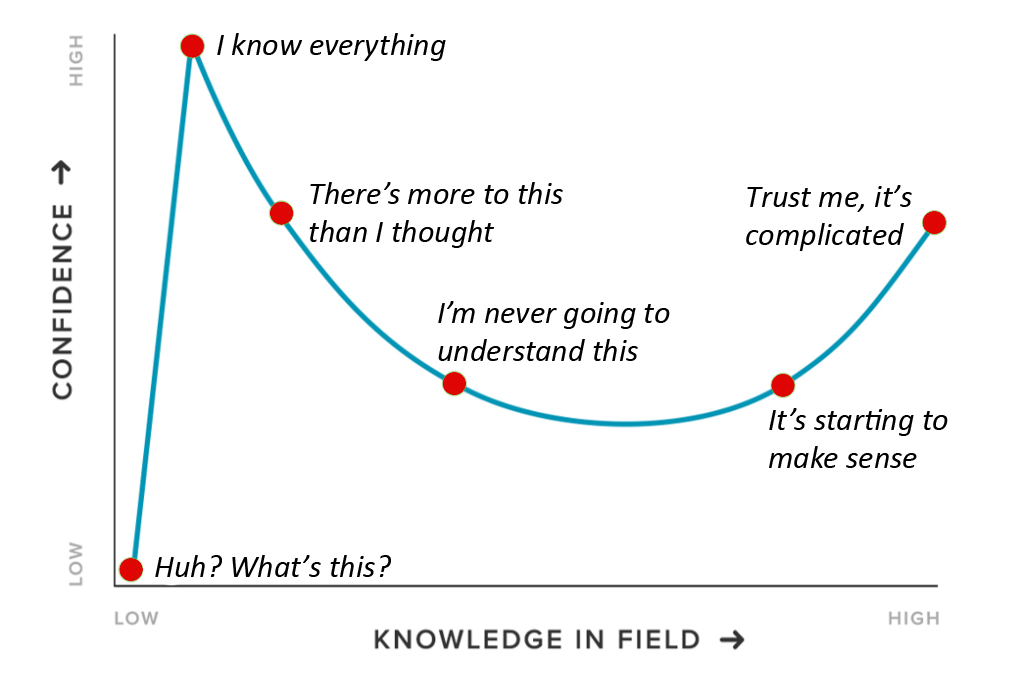
The effect follows a very interesting path. Initially, a person begins from (or close to) the origin when he/she has no prior knowledge of a subject or topic. Then, with only a small gain in knowledge, the person’s confidence surges to a peak point where he/she believes that he/she knows everything about the subject/topic. This is the point where they commit a mistake or error, thereby reducing their confidence after realizing there’s more than meets the eye. The confidence becomes almost inversely proportional to the knowledge being gained until it reaches the lowest in the curve, before gradually increasing again.
Now, how does the Dunning-Kruger effect relate to Islam? Well, the effect has been discussed by Dr. Yasir Qadhi in one of his lectures, where he describes how, even in Islam, there are people who, after gaining only some knowledge, become over-confident and even arrogant in their approach towards others. However, the more knowledge they gain, the more humble they become, because they realize how much they do not know as of yet.
Let us have a look at the verses that support this cognitive bias, and how Islam guides us to avoid it:
1. Refrain from commenting without knowledge

“And do not follow, that of which, you have no knowledge. Indeed, the hearing, the sight and the heart – all those will be questioned.”
– Qur’an 17:36
The first and most important thing to do is to stop following things that we have no knowledge of. For example, if we are unsure of a news we received, we must never forward or spread that news until and unless we have verified it and have gained enough knowledge regarding it.
It usually goes against our ego to admit our lack of knowledge regarding a subject, hence it becomes difficult to acknowledge our shortcomings. At times like these, its important to realize that none of us are perfect and that our capacity is limited. It is only a human nature to not have knowledge about everything and anything, and it doesn’t make us inferior to anyone else.
2. Ask God to increase your knowledge

And say, “My Lord, increase me in knowledge.”
– Qur’an 20:114
Once we’ve acknowledged our lack of knowledge regarding a subject or a field, the first step is to ask God to increase us in knowledge. Now you may ask, why must we ask God to increase us in knowledge and how is this the first viable step?
Firstly, as Muslims, we believe that knowledge comes from God, since God is All-knowing. Secondly, everything in Islam is related to our intention. If our intention is to really seek knowledge to benefit others, surely God will open doors for us. However, if we have ill intentions, then we are bound to be misguided in our pursuit of knowledge.
Thirdly, consider this as the initiation point of your knowledge seeking process. For example, if you wish to search for books on history on Google, you must give the input to the Google Search Engine first before it can generate results for your query. Similarly, we need to first ask God if we are to educate ourselves on a particular topic or subject.
3. Don’t be hesitant to ask others

“Ask the people of knowledge if you do not know.”
– Qur’an 16:43
The next viable step is to seek people who have knowledge in that subject or field and consult them. This doesn’t confine to physically approaching a person or organization to seek knowledge, but watching educational videos, reading articles or books, watching debates, etc. is also included in this step, all thanks to the internet.
Seeking knowledge from experts of a particular field brings forth a lot of unknown facts, hence one must diversify his/her teachers as well.
4. Spread the knowledge

“Whoever calls to guidance, then he receives the reward similar to the reward of whoever follows him, without that diminishing anything from their rewards.”
“And whoever calls to misguidance, then he receives of sin similar to the sins of those who followed him, without that diminishing anything from their sins.”
– Prophet Muhammad ﷺ
[Jami` at-Tirmidhi: 2674]
Once we’ve gained enough knowledge and understanding, it is then recommended to spread that knowledge in order to benefit the society and humanity at large.
Educating those who do not know will also prevent the occurrence of Dunning-Kruger effect, helping them avoid the initial surge in confidence with little to no knowledge. Hence, they’d be able to avoid the crucial mistakes thereby eliminating the Dunning-Kruger effect.
However, it must be noted that the knowledge gained must not be misused in order to harm someone, e.g. spreading hate, brainwashing, etc. The Prophet ﷺ has clearly warned that the law of gaining the same reward, as that gained by the one receiving the knowledge, is also valid for gaining the sins in the similar manner. Hence, we must have good intentions and clear knowledge before imparting it onto others. Even though we cannot have full knowledge of things, we can still educate others within the boundaries of what we’ve learnt.
In conclusion, we find that Dunning-Kruger effect is a very common phenomenon, which, if ignored, can yield some devastating results due to serious mistakes and errors. However, the effect can be avoided if we acknowledge our shortcomings and understand that we know little to nothing. Then, with proper guidance and dedicated pursuit of knowledge, we can not only educate ourselves but also others, and therefore impart beneficial knowledge to mankind at large.
 Revisiting Islam
A very interesting and thought-provoking article which deals with a topic often ignored in our learning environment. This phenomenon obviously holds true for every field of knowledge but I have felt this surge in confidence while gaining new religious knowledge. I have made the same mistake of judging everyone harshly with whatever little information I gained when I was younger. Reading this article made me realise that everyone passes through these stages and that I need to be more persistent in seeking knowledge about God while still remaining humble.
LikeLiked by 1 person
Masha Allah, a good read. Jazak Allah Khair.
LikeLike